India's honey industry is expanding its international presence, generating export revenue and creating opportunities for agricultural diversification. However, behind these achievements lies an important economic contradiction: while the government regulates the minimum export valuation of natural honey, Indian beekeepers still lack a corresponding nationwide Minimum Support Price (MSP) mechanism.
The question is straightforward: If India's honey export industry deserves regulatory price protection, why does the primary producer continue to face substantial market-price uncertainty?
According to APEDA, India exported 114,570.24 metric tonnes of natural honey worth US$206.47 million during FY 2025–26.
Yet, reported mustard honey procurement prices in Punjab declined from approximately ₹148 per kilogram in 2024 to ₹85 in March 2026. Meanwhile, producers reported production costs of around ₹120 per kilogram against market prices of approximately ₹90 in May 2026.
Haryana, in contrast, introduced a protected price of ₹120 per kilogram for eligible beekeepers under its Bhavantar Bharpai Yojana.
To understand the implications of these developments, this investigation examines India's honey economy through the seven essential questions of journalism and economic analysis.
1. WHO: Who Produces India's Honey, Who Controls Its Commercial Supply Chain, and Who Represents the Industry?
India's honey industry involves several participants, including:
Independent beekeepers and small honey producers.
Farmer Producer Organisations (FPOs).
Agricultural cooperatives.
Honey aggregators and traders.
Processing and packaging companies.
Domestic brands and exporters.
International distributors and retailers.
However, these participants do not necessarily possess equal financial resources or bargaining power.
Who Represents the Commercial Interests of the Industry?
The India Honey Alliance (IHA) is an industry consortium representing different stakeholders across India's honey value chain.
Its publicly listed leadership includes representatives affiliated with companies such as Dabur India, Patanjali Ayurved, Hamdard Laboratories, Shree Baidyanath Ayurved Bhawan and Brij Honey.
These organisations contribute commercial experience in procurement, manufacturing, processing, marketing, exports and distribution.
The relevant question is not whether corporate participation is appropriate. It is whether independent beekeepers and small producers have comparable influence in industry-level discussions, procurement negotiations and agricultural policymaking.
Who Performs the Primary Agricultural Work?
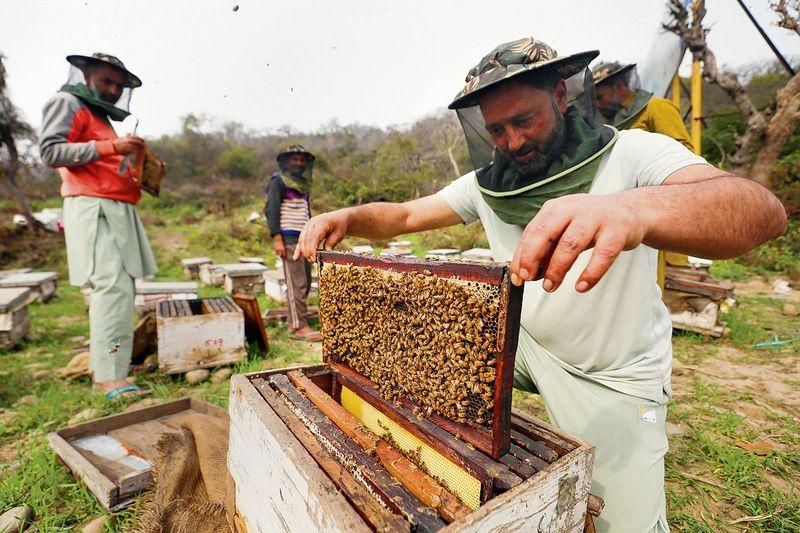
Beekeepers undertake the responsibility of:
Maintaining bee colonies and hives.
Managing seasonal migration according to flowering cycles.
Monitoring colony health.
Collecting and extracting honey.
Managing production-related risks.
Maintaining the quality of harvested honey.
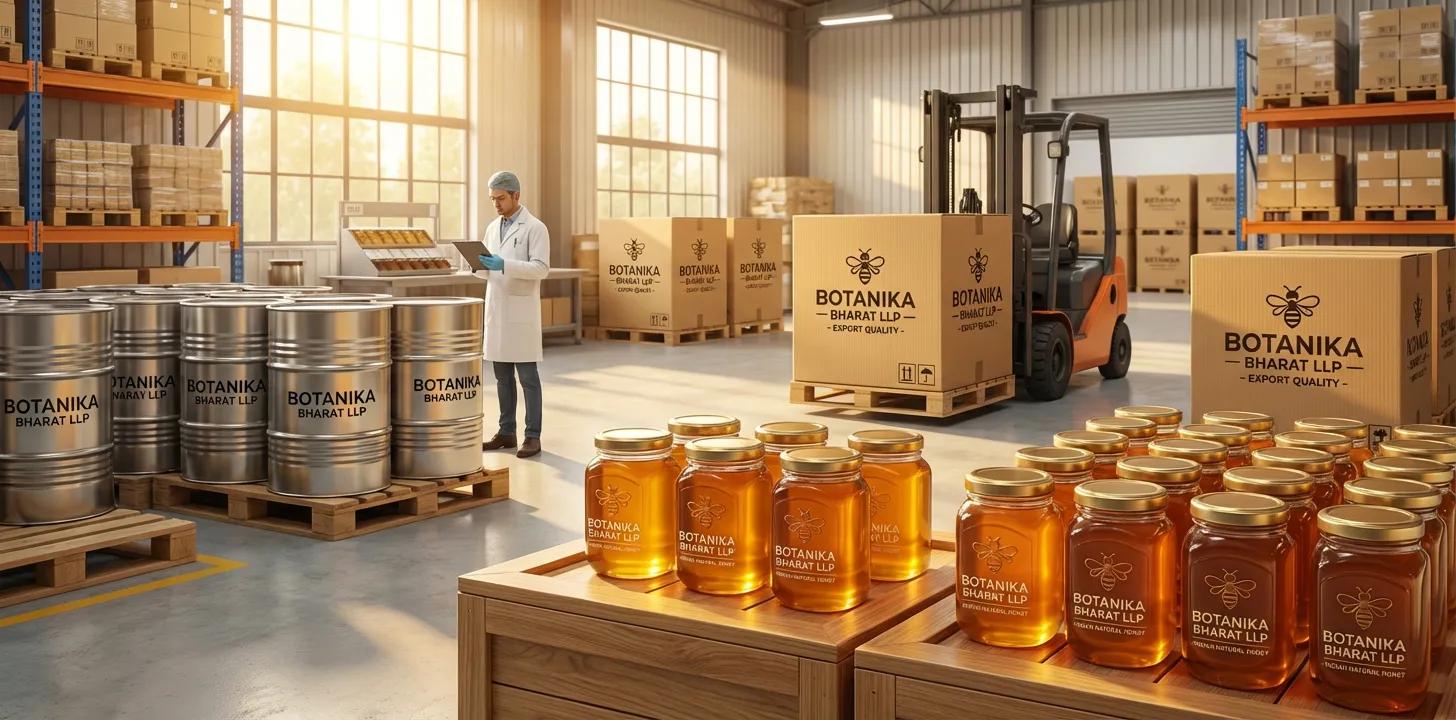
Processors and exporters perform different but equally important commercial functions, including testing, filtration, packaging, documentation, logistics and international distribution.
The central representation question is whether the original producers have sufficient institutional access to influence the decisions that directly affect their livelihoods.
2. WHAT: What Is the Fundamental Economic Problem in India's Honey Industry?
The central problem is the difference between India's growing export performance and the economic uncertainty faced by its primary producers.
Three developments explain this contradiction.
First: Export growth.
India exported approximately 114,570.24 metric tonnes of natural honey worth US$206.47 million in FY 2025–26.
Second: Declining procurement prices.
Reported mustard honey procurement prices in Punjab fell from ₹148/kg in 2024 to ₹85/kg in March 2026.
Third: Production costs exceeding market prices.
Producers reported an estimated production cost of ₹120/kg against a prevailing market price of approximately ₹90/kg in May 2026.
This creates a serious sustainability challenge for small-scale beekeepers.
What Is the Policy Contradiction?
On March 14, 2024, the Directorate General of Foreign Trade introduced a Minimum Export Price (MEP) of US$2,000 per metric tonne for natural honey.
The government subsequently reduced this threshold to US$1,400 per metric tonne in August 2025.
DGFT Notification No. 09/2026–27, dated April 10, 2026, extended the existing US$1,400 FOB condition until December 31, 2026.
However, natural honey is not included in the Central Government's nationwide MSP framework covering 22 mandated agricultural crops.
An export MEP regulates the minimum declared export valuation under the applicable policy. It does not establish a minimum domestic procurement price for beekeepers.
Therefore, the fundamental issue is not the absence of export regulation. It is the absence of a corresponding nationwide honey price-support framework for primary producers.
3. WHEN: When Did India's Honey Price and Policy Contradictions Become Visible?
Several developments between 2024 and 2026 illustrate the changing economic environment.
| Period | Important Development |
|---|---|
| March 2024 | DGFT introduced a US$2,000/MT honey export MEP |
| 2024 | Punjab mustard honey procurement price reportedly stood at ₹148/kg |
| 2025 | Procurement price declined to approximately ₹118/kg |
| August 2025 | Export MEP reduced to US$1,400/MT |
| FY 2025–26 | India exported 114,570.24 MT of natural honey |
| March 2026 | Punjab mustard honey procurement price reportedly fell to ₹85/kg |
| April 2026 | Government extended the US$1,400/MT MEP until December 31, 2026 |
| May 2026 | Producers reported production costs of ₹120/kg against market prices of ₹90/kg |
| May 2026 | Haryana announced ₹1.02 crore in assistance to 30 farmers under its honey support initiative |
| August 2026 | An FPO from Tripura exported one metric tonne of mustard honey to Dubai, facilitated by APEDA |
These developments demonstrate that India's honey industry is experiencing two parallel trends: growing international commercial activity and increasing attention towards producer-level income protection.
4. WHERE: Where Is India's Honey Produced, and Where Is Its Export Value Historically Recorded?
India's honey production is concentrated in agricultural states with substantial beekeeping activity.
According to APEDA, India's honey production reached approximately 152 thousand metric tonnes in FY 2024–25.
The major producing states included:
| State | Share of Production |
|---|---|
| Uttar Pradesh | 16.74% |
| West Bengal | 15.85% |
| Punjab | 13.91% |
| Bihar | 12.35% |
| Rajasthan | 8.84% |
| Combined | 67.69% |
These states represent a significant proportion of India's natural honey production.
However, a historical study published in 2021 using 2017 export data recorded a different geographical distribution of honey export value:
| State | Share of Recorded Export Value |
|---|---|
| Delhi | 75.98% |
| Rajasthan | 11.00% |
| Maharashtra | 5.14% |
| Uttar Pradesh | 4.60% |
| Punjab | 1.91% |
These figures belong to different reporting periods and cannot be directly compared as current production and export shares.
Nor does the location of recorded export value necessarily identify where the honey originated or who owned the exporting business.
Nevertheless, they highlight an important structural distinction.
Honey production is predominantly agricultural, whereas commercial aggregation and export activity can be concentrated in urban trading and business centres.
This makes transparency about the geographical origin of honey, farm-gate procurement prices and value-chain margins particularly important.
5. WHY: Why Are Beekeepers Facing Economic Pressure Despite Growing Honey Exports?
There are several interconnected reasons.
A. Declining Procurement Prices
Reported Punjab mustard honey procurement prices declined from ₹148/kg in 2024 to ₹85/kg in March 2026.
This represents an approximate 42.57% reduction.
Such a decline can significantly affect producers who have recurring expenses relating to labour, colony maintenance, transportation and equipment.
B. Production Costs Exceeding Market Prices
Producers reported estimated production costs of approximately ₹120/kg against market prices of ₹90/kg.
Consider an illustrative production scenario:
| Particular | Amount |
|---|---|
| Honey production | 10,000 kg |
| Production cost per kg | ₹120 |
| Total production expenditure | ₹12,00,000 |
| Selling price per kg | ₹90 |
| Total sales realisation | ₹9,00,000 |
| Illustrative shortfall | ₹3,00,000 |
This is an illustrative calculation based on the reported estimates, not an audited financial statement or a representative figure for every beekeeper.
C. Limited Bargaining Power
Individual beekeepers may lack the negotiating strength of large procurement organisations.
When producers depend on local traders and intermediaries, their ability to influence procurement prices can be limited.
D. Inadequate Market Transparency
Small producers may not have reliable access to information about:
Regional procurement prices.
Quality-based price differences.
International demand.
Export market requirements.
Processing and packaging costs.
Commercial margins across the supply chain.
E. Limited Infrastructure
Insufficient storage, processing and testing facilities can force producers to sell their honey without fully exploring alternative market opportunities.
Consequently, rising export turnover does not automatically translate into improved beekeeper incomes.
6. HOW: How Does India's Honey Industry Operate, and How Can Producers Gain Greater Economic Control?
India's honey supply chain can broadly be represented as:
Beekeeper → Local Aggregator → Processor → Exporter → International Distributor → Retailer → Consumer
Every participant performs a different commercial function and incurs different costs.
However, the original producer may have limited control over the final selling price.
A more balanced supply chain requires several structural improvements.
A. Strengthening Farmer Producer Organisations
FPOs and beekeeper cooperatives can collectively aggregate honey, negotiate with buyers and improve access to institutional markets.
B. Establishing Digital Procurement Platforms
Digital procurement systems can publish regional prices, maintain transaction records and improve price discovery.
C. Improving Quality Testing Facilities
Affordable laboratory facilities can help beekeepers understand the quality of their honey and meet domestic and international requirements.
D. Developing Farmer-Owned Processing Infrastructure
Shared extraction, filtration, storage and packaging facilities can enable producers to participate in additional stages of the value chain.
E. Creating Direct Market Connections
Producer organisations can establish structured relationships with processors, institutional buyers and exporters.
F. Expanding Farmer-Owned Export Opportunities
An important example emerged on August 10, 2026, when APEDA reported facilitating the first-ever export of one metric tonne of mustard honey by Dergang Farmer Producer Organisation from Tripura to Dubai.
This demonstrates that organised farmer-owned enterprises can participate in international honey markets.
One shipment does not establish that every FPO can independently operate an export business. However, it provides an example of how collective production and institutional support can create additional market opportunities.
7. HOW MUCH: How Much Is India's Honey Export Industry Worth, and How Much Does the Original Producer Receive?
This is perhaps the most important financial question.
According to APEDA, India's natural honey exports during FY 2025–26 were:
| Export Indicator | Reported Figure |
|---|---|
| Export quantity | 114,570.24 MT |
| Export value | US$206.47 million |
| Illustrative exchange rate | ₹90/USD |
| Approximate export value in INR | ₹1,858 crore |
| Average export realisation | Approximately ₹162/kg |
The approximate ₹1,858 crore figure represents converted export turnover, not profit.
Similarly, the average export realisation of ₹162/kg is an aggregate figure. It does not represent the amount received by the beekeeper.
Exporters incur expenses relating to aggregation, quality testing, processing, packaging, transportation, documentation, financing and international distribution.
Nevertheless, a critical information gap remains:
How much of the final export value actually reaches the original honey producer?
A transparent national database should ideally disclose:
Average farm-gate procurement prices.
Regional and variety-wise honey prices.
Processing and packaging costs.
Export logistics and compliance expenditure.
Intermediary and commercial margins.
The original beekeeper's share of final export value.
Without this information, export growth cannot independently establish whether the financial condition of India's beekeepers is improving.
The Price Protection Comparison
| Economic Indicator | Approximate Value |
|---|---|
| Average export realisation | ₹162/kg |
| Export MEP equivalent at ₹90/USD | ₹126/kg |
| Reported Punjab production cost | ₹120/kg |
| Haryana protected price | ₹120/kg |
| Punjab procurement price, March 2026 | ₹85/kg |
These figures relate to different dates, markets, product categories and commercial stages. They should not be interpreted as a direct calculation of exporter profit or a uniform national price difference.
Their significance is that they demonstrate the different economic positions of producers, buyers and exporters.
8. WHAT SHOULD HAPPEN NEXT: Seven Policy Reforms for India's Honey Industry
The debate should move beyond identifying the problem and focus on practical improvements.
Shunyatax Global proposes that policymakers, agricultural institutions and industry stakeholders examine the following measures.
1. Examine a Cost-Based Minimum Procurement Price
Commission scientific studies to establish the actual cost of honey production across different states, floral varieties and beekeeping models.
Evaluate whether a cost-linked procurement price or price-deficiency payment mechanism is economically feasible.
2. Publish Transparent Procurement Prices
Establish a publicly accessible digital dashboard showing monthly, regional and variety-wise honey procurement prices.
3. Strengthen Independent Beekeeper Representation
Ensure meaningful participation by independent beekeepers, cooperatives, FPOs and producer organisations in agricultural and export-policy consultations.
4. Support Farmer-Owned Processing and Export Businesses
Provide suitable technical and institutional assistance for processing facilities, laboratories, packaging, storage, branding and export documentation.
5. Expand Direct Export Opportunities
Develop programmes connecting eligible FPOs with international buyers and improving their understanding of export regulations and commercial requirements.
6. Establish Producer-Level Traceability
Introduce digital batch identification and procurement records connecting honey products with their original production sources.
7. Publish the Beekeeper's Share in the Value Chain
Commission regular studies examining how export revenue is distributed among original producers, aggregators, processors, packaging businesses and exporters.
Conclusion: India's Sweet Revolution Must Also Be Profitable for Beekeepers
India's honey industry has established a meaningful presence in international markets. Its production capacity, agricultural diversity and export potential create opportunities for rural enterprises and commercial businesses alike.
However, the long-term success of this industry cannot be measured exclusively through export volumes, foreign exchange earnings or corporate turnover.
It must also be measured through the financial sustainability of the people who maintain bee colonies and produce the honey.
The debate should not be framed as farmers versus corporations. Processors and exporters perform essential functions, and their commercial success is an important part of the agricultural export economy.
The real objective should be to create a value chain in which producers receive fair market opportunities, businesses remain competitive and consumers receive quality-assured products.
India has developed a regulatory framework for honey export valuation. The next policy challenge is to strengthen producer-level income security, bargaining power, market transparency and ownership of the value chain.
The real success of India's Sweet Revolution will be determined not simply by how much honey India exports, but by how sustainably its beekeepers earn from producing it.
The question India must ultimately answer is simple: Who creates the honey, who captures its economic value, and what mechanisms ensure that the original producer is not left behind?
— Shunyatax Global | Independent Business, Finance and Policy Analysis
About Shunyatax Global: Shunyatax covers developments in India's economy, agricultural markets, taxation, international trade, business regulations and financial policy to help readers understand the economic forces shaping businesses and livelihoods.
Disclaimer: This article is intended for general informational, educational and public-policy discussion. Reported procurement prices and production costs relate to specific reports and locations and should not be treated as uniform prices across India. The illustrative export conversion uses an assumed exchange rate of ₹90 per US dollar. The article does not constitute legal, financial or investment advice.